|
|
Rabbi Mordechai Eliyahu זצ״ל
At a shloshim
commemoration in Queens, stories from those who knew the former
Sephardic Chief Rabbi
By Judah S.
Harris
Thirty days following
the burial of a loved one marks a transition from
one stage of Jewish mourning to another, and an additional time to
reflect publicly on the life of the individual. Stories flow freely
during the shivah period, but with the arrival of the shloshim, more
organized memorial programs, be they in the daytime or evening, provide
an added opportunity, now with some distance from the time of death,
for the family and the community to give respect and gain inspiration.
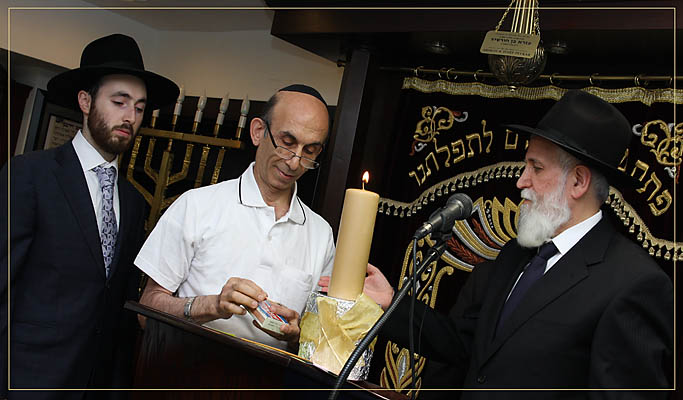
At an important shloshim
program held in Kew Gardens Hills last Tuesday
evening, participants gained a better appreciation for the man who was
best known as having held the position of Chief Sephardic Rabbi of the
State of Israel, from 1983-1993.
Rabbi Mordechai Eliyahu
was 81 years old when he passed away in
early-June following a year of illness and hospitalization. Rabbi
Ya’aqob Menashe, founder and spiritual leader of Midrash Ben Ish Hai,
an educational organization started in the 1980s with activities in the
New York area, and the hosts of the shloshim event, stressed however
that Rabbi Eliyahu’s accomplishments extended beyond his most public
role - the official title and the well-known image of a distinguished
bearded man dressed in ceremonial robe with a blue turban that had
become familiar to many.
“People don’t realize
his greatness. People know he was a chacham…
Chief Rabbi in Israel…” began Rabbi Menashe, as he started to reveal
more. “He was humble; he made you feel as if you were his equal.”
Despite his stature, his accomplishment in learning, and his mastery of
mystical texts, Rabbi Eliyahu was accessible to everyone. He loved all
Jews and was sought out by all segments of society.
His character – or what
we would term in Jewish discussion, “midot” –
was legendary, as attested to by those who knew him personally,
individuals such as Rabbi Menashe, Rabbi Eliyahu Ben-Chaim, from the
neighborhood and a Rosh Yeshiva at Yeshiva University, who also
presented at the program (he spoke in Hebrew), and those who offered
ample testimonials that were included in a 40-minute film that was
rushed to Midrash Ben Ish Hai just in time for the event held at their
new Queen’s Beit Knesset and Beit Medrash. The same video, created
especially for the shloshim, was shown earlier in the day at the
Binyanei Hauma auditorium in Jerusalem. “We are the only people
in America showing it tonight,” said Rabbi Menashe to the audience of
close to 150 that had joined to pay tribute and learn more about Rabbi
Eliyahu.
From the more profound
moments to the small details, lessons can be
transmitted from the entire span of a righteous person’s life. Rabbi
Eliyahu loved Yerushalmi kugel, said one commentator on film, citing a
fact that might imply more trivia than Torah, and although he could
have eaten more when served what was for him a true delicacy, he
sufficed with a very small amount, sharing the rest, the shiraim, the
remainders with those who were around him. The moral: Some people think
righteous people do not have temptations; they don’t experience desire.
Tzadikkim always have temptations, but they have the inner strength to
resist them.
In all areas of eating,
Rabbi Eliyahu exercised the greatest of
care. “He only ate his wife’s cooking,” said Rabbi Menashe.
“So when he traveled, only bread and water.” (Sephardim are
stricter than Ashkenazim in regards to bishul akum, requiring Jewish
involvement during all phases of food preparation, and Rabbi Menashe
used this occasion to caution those in attendance, a mostly Sephardic
audience, to be more diligent when choosing kosher restaurants that
might be perfectly acceptable for Ashkenazim but not Sephardic
diners.) From the age of bar mitzvah, Rabbi Eliyahu avoided beef,
and he only ate chicken that had been shechted for him or that he
slaughtered personally.
He was also strict
regarding drinking wine. Even yayin mevushal,
pasteurized or cooked wine, would not be acceptable to him if the
bottle had been opened.
Although at times
adopting a more machmir, stringent stance than what
he ruled for others, he did not seclude himself from the population at
large and reached out to all segments of the community throughout his
lifetime.
Rabbi Eliyahu accorded
great honor to others. “He interacted with
people as if they were friends,” said Rabbi Ben-Chaim, calling him
“singular in his generation.” “A first grader or the prime minister –
the same honor,” proclaimed a teacher in the video, whose students had
received visits from the rabbi on more than one occasion. Rabbi Eliyahu
continuously stressed how to treat fellow Jews, illustrating by his
personal example. He visited secular kibbutzim, where Torah knowledge
was largely absent, and in at least one instance told residents that he
was “jealous of them” about one thing. They were surprised by the
rabbi’s statement, but he explained that he was jealous that they “knew
that they didn’t know.” Many people, even the religious, remain
unaware of the gaps in their understanding, fundamental pieces that are
missing, but their absence goes unnoticed.
Secular individuals
could respect Rabbi Eliyahu because he respected
them. Four men, very distant from religion (accessorized with
earrings and dressed in a blatantly irreligious fashion) once asked the
rabbi for a blessing. He graciously provided one before getting into
his car to leave. However, moments later he emerged from the car and
began to dance with the men, asking them to also join him in reciting
the Hebrew words of the song taken from prayer.
Although Rabbi Mordechai
Eliyahu was born in Israel, his family
originated in Baghdad, and were people of means. His father, Rabbi
Salman Eliyahu, was brilliant and excelled in his academic studies. By
the time he reached young adulthood, plans were made to send him to
London to study business. These plans changed radically when Salman
encountered Baghdad’s Midrash Beit Zilkha, a yeshiva and rabbinical
college originally established in 1840 that produced generations of
Iraqi Jewish religious leadership. He was awed by the amount of seforim
he saw at the yeshiva and chose to enroll in the school, where he
learned from the great scholars of the time, including the Ben Ish Hai
who had tested Salmon and quickly recognized his genius. “That was the
beginning of a very close bond between the two of them,” Rabbi Menashe,
told the audience. (Rabbi Menashe is also of Baghdadi background. He
was born in Bombay and in 1965 moved to London.)
The family immigrated to
Israel and Rav Mordechai was born in 1929 in
the Old City. He studied intensively with his father, who passed away
when the boy was only 11, leaving young Mordechai bereft of not only a
father but also “his rabbi,” said Rabbi Menashe. He “was taken under
the wing of some great luminaries,” who Rabbi Menashe listed: Rabbi
Yitzchok Nissim, the Hazon Ish, and Rabbi Ezra Attiah, the Syrian-born
rabbi who served as Rosh Yeshiva of Porat Yosef until his death in
1970. Rabbi Eliyahu studied at the Porat Yosef yeshiva, as did Rabbi
Ovadiah Yosef, although their halachic rulings differed in a number of
areas, and each maintained alternate approaches to Sephardic practices
and customs, and how to best retain them.
In 1959, Rabbi Eliyahu
became the youngest dayan to be appointed in the
State of Israel. Over the decades his knowledge and insight was sought
out by mekubalim, dayanim, and roshei yeshiva who would visit to ask
questions. Rabbi Eliyah would answer, and ordinary people would also
come to ask and to learn.
100,000 gathered for his
nighttime funeral held at Rabbi Eliyahu’s
synagogue and outside on Reines Street in Jerusalem’s Kiryat Moshe
neighborhood. During the week of mourning, people arrived to console
the family and to share previously untold stories. There are many
episodes that attest to Rabbi Eliyahu’s greatness and how he was
personally impacted by current events that afflicted the Jewish people.
He was a strong Religious Zionist, outspoken about the disengagement
from Gaza, and cared deeply about the loss of life at the hands of
Israel’s enemies.
In 2008, Rabbi Eliyahu
responded strangely when invited to a Torah
dedication at the Ohr Somayach yeshiva, Rabbi Menashe related. He
started crying and said, “I hope it will snow that evening.” He called
for organized prayers at the Kotel and lots of Merkaz HaRav yeshiva
students came. The program was dragged out, and when a bus of students
from that yeshiva finally left, it got stuck at a police checkpoint.
This was a Thursday evening, the same night as the terrorist
infiltration of the Yeshiva’s library, which resulted in the deaths of
eight students.
“Some say he had Ruach
HaKodesh,” said Rabbi Menashe. “Here and there
people have.” There are other narratives told: wondrous stories of
healing, of rainfall that fell in an unusual manner to fill a parched
mikvah. Rabbi Eliyahu is known to have studied Kabbalah, as did his
father (intensely), a disciple of the Ben Ish Hai, himself a master of
Kabbalah and Halacha. Rabbi Eliyahu made little mention of it. “He
dealt with it quietly, and only once in a while would he give out any
hints,” Rav Eliyahu Bakshi-Doron, who succeeded Rabbi Eliyahu as Chief
Sephardic Rabbi in 1993, told Arutz-Sheva last month. “He never said he
learned Kabbalah,” shared Rabbi Ben-Chaim, who had
had opportunity to host him in New York, “but he knew it all.”
Yet, the more overt
contributions were in the areas of scholarship.
“His seforim are written in such a beautiful, lucid style – Halacha,
Taharat HaMishpacha…” said Rabbi Menashe, who received his semicha from
Rabbi Eliyahu and a number of other rabbanim. Rabbi Eliyahu wrote on
the halachot of the moadim, edited annotated siddurim, and published
halachic works, including his own responsa.
Video footage of Rabbi
Eliyahu teaching appears a number of times in
the video that was shown on Tuesday. He is seen on occasion giving a
public shiur, seated at a table, speaking clearly in a projected,
strong voice. In front of the rabbi there are seven seforim, in piles
and each with inserted slips of paper marking reference points. A
partially drunk cup of water is also there and becomes a more integral
part of the scene when Rabbi Eliyahu explains to his listeners why it
is that he does not make a blessing out loud before drinking, out of
concern for an Amen Yetoma, an improperly answered Amen (perhaps
because someone will not hear the bracha itself, but will hear the
crowd responding Amen and respond with them, a topic which is ruled on
by Rabbi Haim Palachi, the Kaf Ha'haim, as he negotiates the differing
opinions of the Mechaber of the Shulchan Orach and the Rama).
Rabbi Eliyahu loved
halacha as well as his fellow man. A primary lesson
from his life, said Rabbi Menashe, is to “learn to love each other.”
Societal-problems infect Jewish life today in Israel, America and
elsewhere. The Second Temple was destroyed for similar reasons and “the
Third Beit HaMikdash is not here,” concluded Rabbi Menashe. “So, we’re
still guilty of it.”
This
article was first
published in The Jewish Star: www.thejewishstar.com
Midrash
Ben Ish Hai runs
Torah
educational
programs for adults and
singles and maintains a rich website of materials, including videos and
recipes. www.midrash.org
Judah S.
Harris is a
photographer,
filmmaker, speaker and
writer. He
photographs family celebrations and a wide range
of corporate, organizational and editorial projects in the US, Israel
and other countries. Judah's photography has appeared in museum
exhibits, on the Op-Ed Pages of the NY Times, on the covers of more
than 40 novels, and in advertising all over the world. His work
can be seen in
a frequent email newsletter that circulates to thousands of
readers who repeatedly praise the quality of Judah's photography and
writing. To learn more about Judah S. Harris, visit www.judahsharris.com/visit.
|
|